Solar ATAP 2026: 3 Hidden Risks (and How to Avoid Them)
Welcome to the future of solar energy in Malaysia. As of January 1, 2026, the Solar Accelerated Transition Action Programme (ATAP) has replaced the previous Net Energy Metering (NEM) scheme.
Warning: The rules have changed. The old strategy of "installing the biggest system possible" will now lose you money. This guide explains why.
Quick Definition: What is Solar ATAP?
Solar ATAP (Accelerated Transition Action Programme) is the 2026 renewable energy scheme replacing NEM 3.0. Unlike the old "1-to-1 offset," Solar ATAP uses a Net Billing system where you sell excess power at a lower market rate (SMP) and buy at the retail rate.
Why Did Malaysia Replace NEM with ATAP?
By May 2025, NEM Rakyat's residential quota was 99.8% exhausted. The government extended quotas multiple times before transitioning to Solar ATAP — a no-quota system designed to scale with demand.
Source: SEDA Malaysia
ATAP Sizing Improvements
Bigger systems now allowed
| User Type | NEM 3.0 | Solar ATAP | Change |
|---|---|---|---|
| Residential (3-phase) | 12.5 kW | 15 kW | +20% |
| Commercial/Industrial | 60-75% of MD | 100% of MD | +33-67% |
The Financial Trap: "No Rollover"
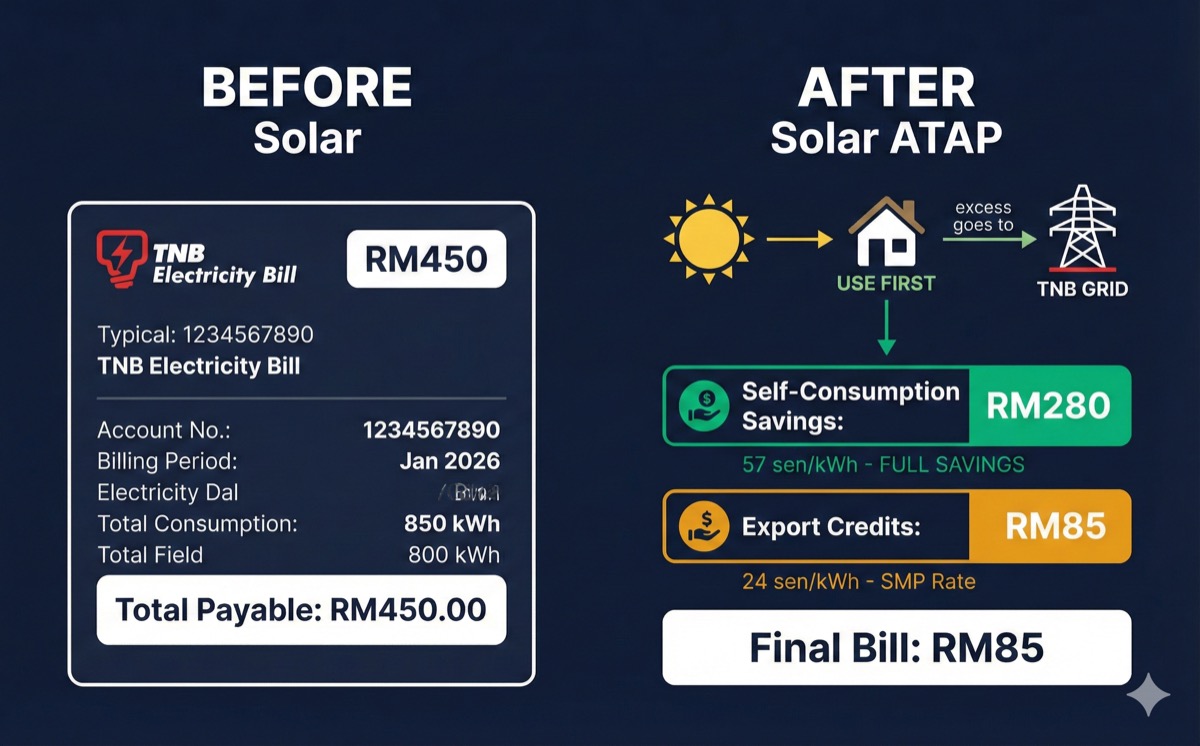
Under the new Solar ATAP scheme, your savings are calculated differently
The primary goal is to use the electricity you generate rather than exporting it. Understanding this fundamental shift is critical to maximizing your ROI.
Self-Consumption
Saves you the full retail rate (e.g., 57 sen/kWh). This is where your real savings come from.
Export Credits
Sold to TNB at the System Marginal Price (SMP), approx 24 sen/kWh - less than half the retail rate.
The Risk: Unused credits are forfeited at month-end. They do not roll over. If you oversize your system, you lose money every single month.
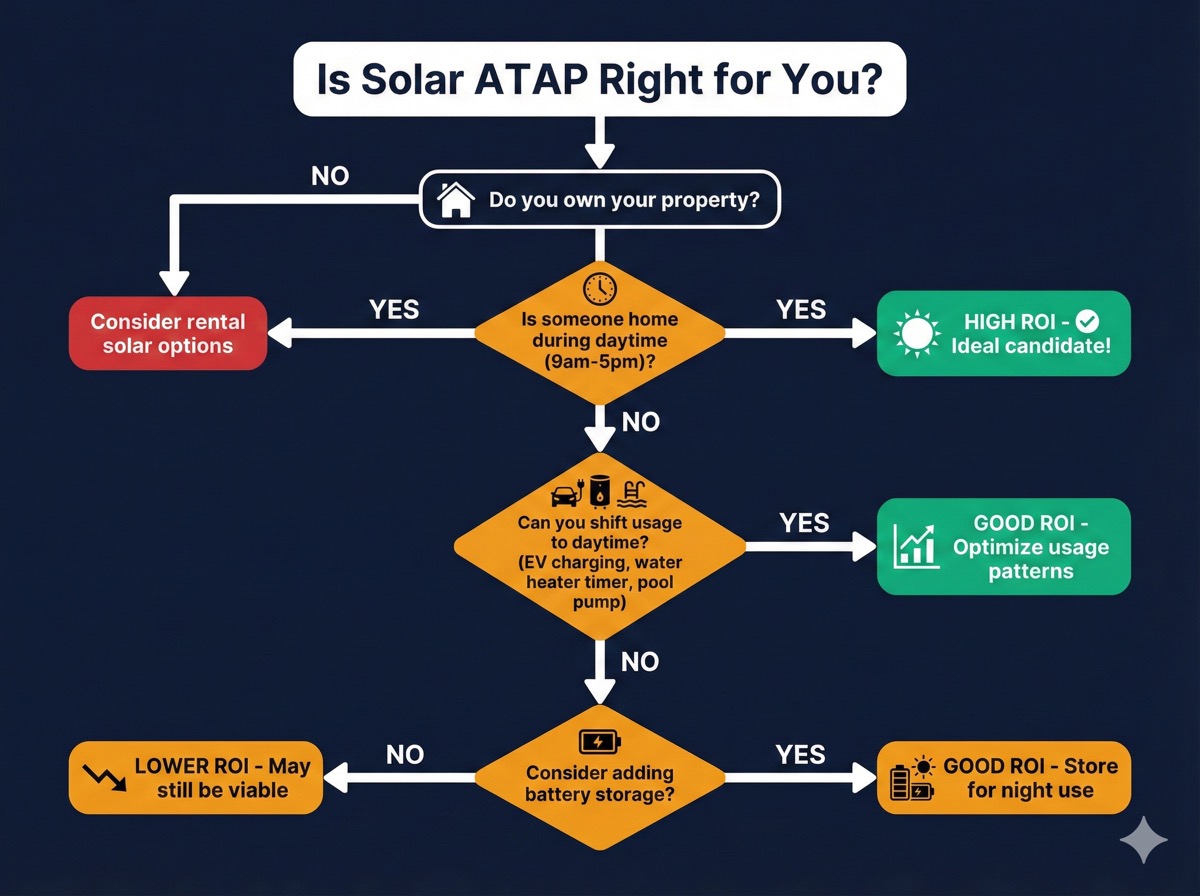
Eligibility: Is Solar ATAP Right for You?
Solar ATAP favors homes with high daytime usage
If you are never home during the day, your ROI will drop significantly unless you add batteries. Follow this decision tree to see if you are the ideal candidate:
NEM 3.0 vs. Solar ATAP: The Breakdown
Understand the "downgrades" in the new system so you can plan around them
What's Changed?
See the key differences at a glance
| Feature | NEM 3.0 | Solar ATAP |
|---|---|---|
| Export Rate | 1-to-1 Offset (Retail) | SMP / Energy Charge |
| Quota | Limited (First come) | No Fixed Quota |
| System Sizing | 75% Max Demand | 100% Max Demand |
| Credit Rollover | 24 Months | Same Month Only |
| Contract Duration | Lifetime of System | 10 Years |
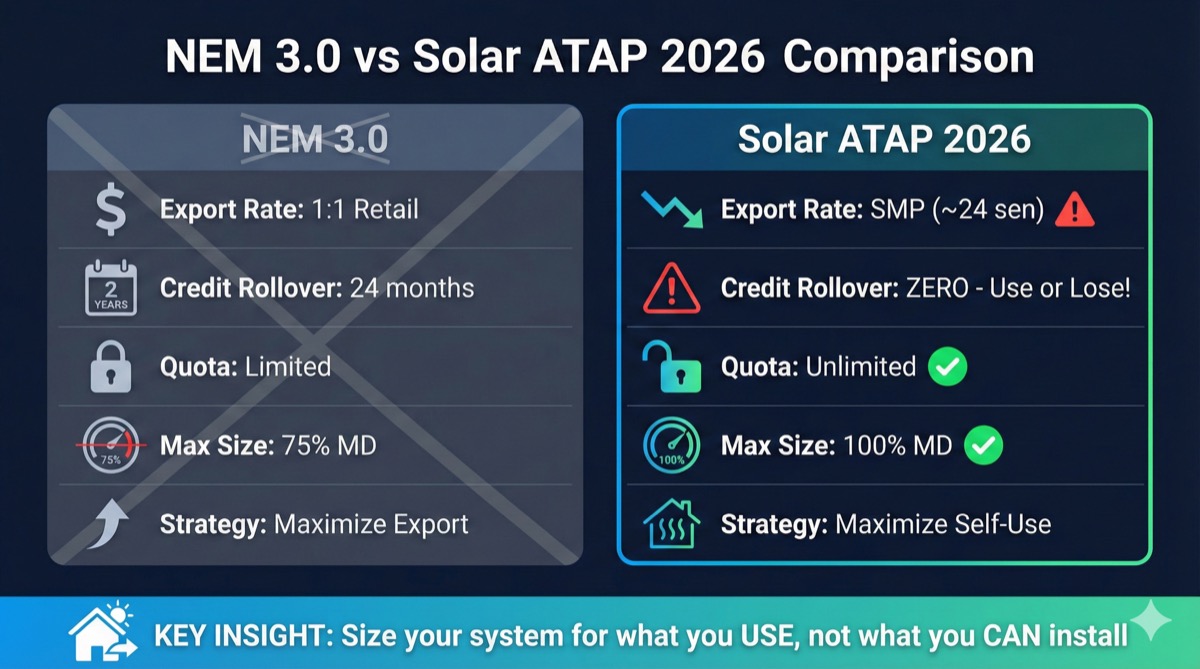
Bottom Line: Solar ATAP favors self-consumption over export. Size your system to use most of the energy yourself for the best ROI.
Understanding SMP (System Marginal Price)
How your export credits are calculated under Solar ATAP
Market-based Energy Offset Rates
Commercial & Industrial: Export credits valued at the Average System Marginal Price (SMP) - a market-driven wholesale rate determined by the New Enhanced Dispatch Arrangement (NEDA). SMP fluctuates based on real-time electricity demand, generation capacity, and fuel costs.
Residential: Export credits at the Energy Charge rate based on your consumption tier - approximately RM0.27/kWh if monthly usage is ≤1,500 kWh, or RM0.37/kWh if usage exceeds 1,500 kWh.
Note: Credits can offset your electricity usage, but they cannot be used to offset Automatic Fuel Adjustment (AFA) charges or other non-energy components of your bill.
Pro Tip: Since export rates are lower than retail tariff, battery storage becomes more attractive. Store excess energy for night use instead of exporting to maximize savings.
Solar ATAP Eligibility
Requirements for residential, commercial, and industrial applicants
Residential
Homeowners with TNB accounts can install rooftop solar systems.
- Single-phase: Up to 5 kWac
- Three-phase: Up to 15 kWac
- Larger systems require TNB technical assessment
- Export at Energy Charge rate
Commercial
Offices, shops, and commercial buildings.
- Up to 100% of Max Demand
- Capped at 1 MWac
- Export at SMP rate
Industrial
Factories, warehouses, and manufacturing facilities.
- Up to 100% of Max Demand
- Capped at 1 MWac
- Export at SMP rate
Important: If you currently have an active NEM contract, you must terminate it before applying for Solar ATAP. You cannot have both schemes simultaneously.
How to Apply for Solar ATAP
Simple steps from assessment to commissioning
Appoint a Registered PV Service Provider (RPVSP)
Engage an RPVSP who will manage the end-to-end application process on your behalf, including site assessment and system design.
TNB Technical Assessment
Your RPVSP obtains technical clearance from TNB via Connection Confirmation Check (CCC) for domestic or Connection Assessment Study (CAS) for larger systems.
System Installation
Once TNB technical clearance is obtained, your RPVSP installs the solar PV system on your rooftop.
SEDA Application & Documentation
Submit application to SEDA with required documents: Solar ATAP Contract, Form G & H (single-line diagrams), Testing & Commissioning Form, and competent person certificates.
Commissioning & Contract Execution
Upon SEDA approval, TNB installs the export meter. Your Solar ATAP contract is executed and export credits begin.
Official application channels & guidelines
Apply and verify every requirement directly with the government bodies running Solar ATAP and the SuRIA Home rebate:
- eATAP online application system (SEDA) — the official Solar ATAP application portal
- How to apply for Solar ATAP (SEDA) — step-by-step guide & registered service-provider directory
- Solar ATAP guidelines (Energy Commission, PDF) — official programme guidelines document
- Solar ATAP & SuRIA Home on myTNB — TNB commissioning details & the official SuRIA Home FAQ
Frequently Asked Questions
Quick answers about Solar ATAP
Is Solar ATAP worth it compared to NEM?
Yes, for most users. While the export rate is no longer 1-to-1, Solar ATAP offers no quota restrictions, larger system sizes (100% vs 75% Max Demand for non-domestic), and year-round applications. The key is sizing your system to maximize self-consumption rather than export.
What happens to my existing NEM contract?
Existing NEM contracts continue until their expiry date. You cannot participate in both NEM and Solar ATAP simultaneously. If you wish to switch, you must terminate your existing NEM contract first.
Should I add battery storage?
Battery storage becomes more attractive under Solar ATAP since export rates are lower than retail tariff. Storing excess for night use maximizes self-consumption and reduces reliance on grid imports, improving your overall ROI.
What is a Registered PV Service Provider (RPVSP)?
An RPVSP is a company registered with SEDA Malaysia to design, install, and commission solar PV systems. They handle the entire application process including TNB technical assessment and SEDA registration on your behalf.
Can I claim GITA tax incentive?
Yes. The Green Investment Tax Allowance (GITA) is separate from Solar ATAP and has been extended through 2026. Businesses can claim 100% tax allowance on qualifying solar and battery storage investments via MIDA.
What is Connection Confirmation Check (CCC)?
CCC is a technical assessment by TNB required before installing a solar system. For domestic systems ≤72kW, no detailed study is required. Larger systems need a Connection Assessment Study (CAS) or Power System Study (PSS).
How to Stay Safe?
Don't risk oversizing your system. The new "use it or lose it" rule means accuracy is everything. Contact us today for a free usage profile analysis. We calculate your exact daytime load to ensure you never waste a single credit.