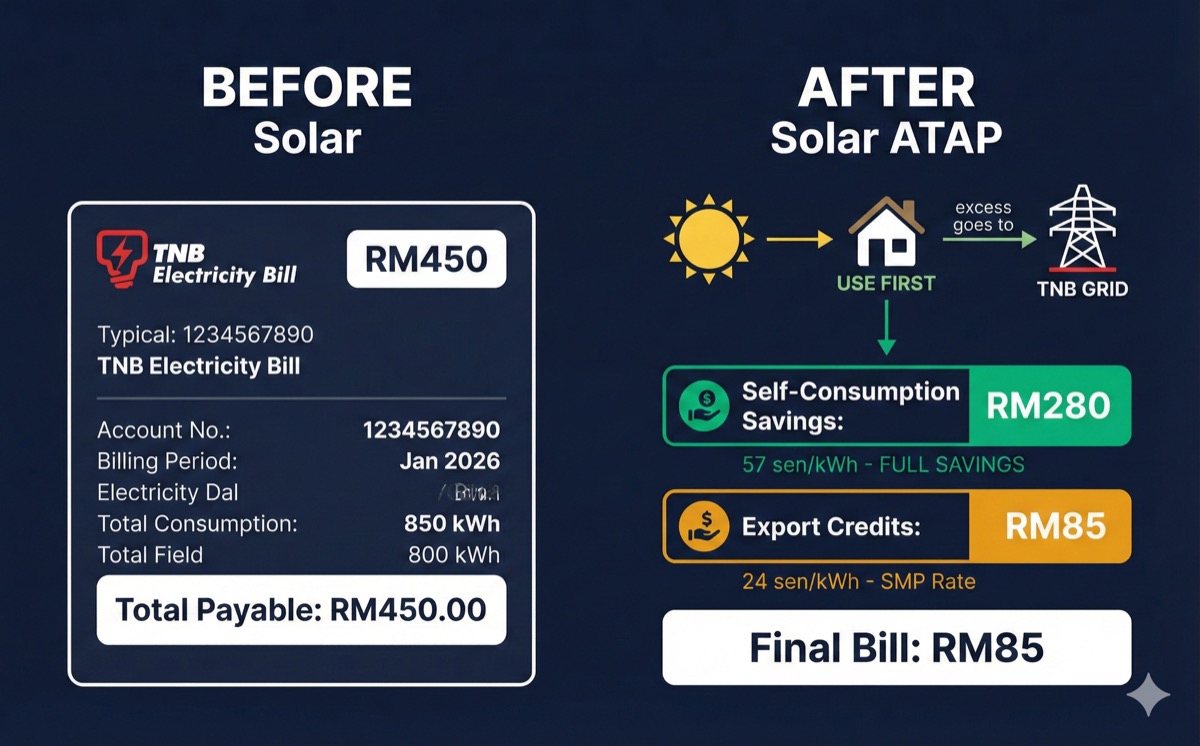
Solar ATAP export rate is the value TNB credits for each kWh of solar you send back to the grid. Under Solar ATAP, businesses earn the average System Marginal Price (SMP) and homes earn the Energy Charge rate. Both sit below the retail tariff you pay for grid power, so the export rate decides how big your system should be.
Quick answer: SMP rate 2026
Average SMP (7am to 7pm) was RM0.1911/kWh in January 2026 and RM0.1893/kWh in February 2026, after the Grid System Operator recalculated both months for a gas price revision. Single Buyer publishes the figure each month. [Source: Single Buyer]
1. Solar ATAP export rate for homes and businesses
The Solar ATAP export rate depends on your TNB account type:
- Domestic (homes): exports are credited at the Energy Charge component of your TNB tariff.
- Non-domestic (shops, offices, factories): exports are credited at the average SMP issued by Single Buyer.
- Same month only: credit offsets usage in the same billing month. Unused credit is forfeited.
- Energy only: credit does not offset AFA or other non-energy charges on your bill.
- 10-year contract: after the Solar ATAP contract ends, exported energy earns no offset and the system runs for self-consumption only.
The Energy Commission set these rules in the Solar ATAP guidelines released on 30 December 2025. [Source: Baker McKenzie] [Source: SEDA]
2. What is the SMP rate?
SMP rate is the energy price of the most expensive thermal generator dispatched to meet demand in each half-hour period, as defined by the Energy Commission. Fuel prices, system demand and generation conditions move it up and down. [Source: Energy Commission]
Single Buyer, the market operator for Peninsular Malaysia, publishes the half-hourly SMP and a monthly average for the 7am to 7pm window. Solar ATAP uses the monthly average SMP to value business exports, since rooftop solar generates in daylight hours.
3. SMP price Malaysia: latest and past figures
| Period | Average SMP | Source |
|---|---|---|
| January 2026 (7am to 7pm, revised) | RM0.1911/kWh | Single Buyer |
| February 2026 (7am to 7pm, revised) | RM0.1893/kWh | Single Buyer |
| Energy Commission performance booklet (published March 2026) | 20.30 sen/kWh | Energy Commission |
| 2022 full year | 24.60 sen/kWh | Single Buyer MESI Factsheet |
| 2021 full year | 16.95 sen/kWh | Single Buyer MESI Factsheet |
The SMP swings with fuel prices. In 2022, SMP ranged from a low of 19.45 sen/kWh (18 September) to a high of 77.67 sen/kWh (11 November). Use the latest monthly average when you check a solar proposal, and ask your provider which SMP figure the savings model assumes. [Source: Single Buyer]
4. What the Solar ATAP export rate means for your savings
Take a factory exporting 2,000 kWh in a month. At an average SMP of RM0.19/kWh, the export credit is about RM380. The same 2,000 kWh used on site during working hours avoids the full tariff for those units, which sits well above the SMP.
Four ways to size around the export rate:
- Size for daytime load. Match the system to what your premises uses from 8am to 6pm, not to your full monthly bill.
- Shift flexible loads into daylight. Run pumps, compressors, chillers or batch processes while the sun is up.
- Check the self-consumption ratio. A good proposal shows how many kWh you use on site and how many you export.
- Consider storage for evening peaks. A battery stores surplus solar for later use. See our solar battery price guide.
5. Solar ATAP export rate vs NEM 3.0, SELCO and FiT
- NEM 3.0: exports were credited 1:1 at the retail rate, with unused credit carried forward up to 24 months. Read Solar ATAP vs NEM 3.0.
- SELCO: no export credit. All generation is for self-consumption. Read SELCO vs ATAP.
- FiT: Feed-in Tariff rates do not apply to new Solar ATAP systems. New rooftop systems export under Solar ATAP.
Bottom line
The Solar ATAP export rate paid about RM0.19 per kWh for business exports in early 2026. Your savings come from solar you use on site. Size the system to your daytime load, check the SMP figure in every proposal, and treat exports as a bonus.
For the full rules, read our Solar ATAP Malaysia 2026 guide or try the solar cost calculator.
Frequently asked questions
What is the Solar ATAP export rate?
The Solar ATAP export rate is the Energy Charge rate for homes and the average System Marginal Price (SMP) for businesses. Credit offsets usage in the same billing month only, and unused credit is forfeited.
What is the SMP rate in 2026?
Single Buyer reported an average SMP (7am to 7pm) of RM0.1911/kWh for January 2026 and RM0.1893/kWh for February 2026, after a gas price revision. Check the Single Buyer website for the current month.
Does unused Solar ATAP export credit roll over?
No. Under Solar ATAP, export credit offsets usage in the same billing month. Unused credit is forfeited, unlike NEM 3.0 where credit carried forward up to 24 months.
Does Solar ATAP export credit offset AFA charges?
No. Export credit offsets energy usage only. It does not offset the Automatic Fuel Adjustment (AFA) or other non-energy charges on your TNB bill.
What is the FiT rate for solar in Malaysia?
Feed-in Tariff (FiT) rates do not apply to new Solar ATAP systems. New rooftop systems export at the Energy Charge rate (homes) or the average SMP (businesses).
Sources & further reading
- Single Buyer: System Marginal Price: monthly average SMP
- Energy Commission: What is SMP
- SEDA Malaysia: Solar Accelerated Transition Action Programme
- Baker McKenzie: Malaysia: 2026 Updates to Renewable Energy Schemes
- Single Buyer: MESI Factsheet 2022
- Single Buyer: MESI Factsheet 2021
- Energy Commission: ST Performance Booklet